
The media monitoring industry continues to expand as organizations face an increasingly complex information environment and demand faster, more actionable insights. While North America dominates with over 35% of the market share, the addition of AI as a media monitoring platform tool will increasingly drive global growth—both geographically and financially.
Media monitoring traditionally refers to the practice of tracking brand mentions, competitors and industry topics across news, broadcast, podcasts, online video, and other various other online and offline sources. In practice, media monitoring tracks and analyzes various media, with the goal of turning the mentions into actionable intelligence that teams can use to shape narratives and stay competitively adept.
Four developments are shaping the industry now more than ever:
- Demand for more trusted and actionable content and sources: Organizations have long tracked traditional media, social platforms, podcasts, online video and other digital sources. The growing amount of data added through AI has significantly increased the demand for trusted, actionable sources, such as traditional news channels and proprietary audio and video options.
- Faster market signals: Communications leaders need timely evidence of reach and message penetration, and early warning signs of risks to their brand reputation.
- New AI competitors have changed the competitive landscape: Broad communications and specialized monitoring platforms now compete alongside even more social listening providers, regional services and AI native monitoring companies.
- A shift toward intelligence: AI, historical datasets and integrations are increasingly turning media coverage into decision-making intelligence.
What is the Growth of the Media Monitoring Industry?
The media monitoring industry has always been an important part of the communications technology and business intelligence landscape. Its growth reflects organizations’ need to understand not only what is being said about them, but also where conversations originate, how narratives develop, and what those conversations mean for their business. Over the past decade, media monitoring has become an important part of how communications teams report and act upon signals and results.
Global Market Insights valued the media monitoring tools market at $3.5 billion in 2022 and projected it to reach $12.3 billion by 2032, representing a forecast compound annual growth rate of 14% from 2023 to 2032. IMARC Group estimated the market at $5.1 billion in 2024 and forecasts it to reach $12.97 billion by 2033. These figures provide directional evidence of growth, but differences in the categories of software, services and monitoring channels included make direct comparisons difficult. [Sources: Global Market Insights; IMARC Group]
The market generally encompasses several overlapping segments:
- Print and online news: Newspaper, magazine, publication and digital news coverage.
- Broadcast: TV and radio programming, including searchable transcripts and recorded clips.
- Social media: Public conversations, engagement, sentiment and emerging topics across social media platforms.
- Podcasts: Spoken-word content that can reveal commentary, interviews, product discussions and industry trends.
- Online video: Video content from social media, digital publishers, platforms and other online sources.
- Online audio: Audio content from various platforms and specialized sources has become an increasingly valuable source of intelligence in the AI era.
- Other sources: These include online news, print, social media and other specialized sources.
For buyers, the important question is not simply the size of the market. It is also whether their monitoring provider captures the sources that matter most to their organization and surfaces them in ways that create reliable, accessible and actionable intelligence.
What is Driving Media Monitoring Purchase Decisions Today?
Several forces impact how organizations view the benefits of media monitoring, and how they rely on it for strategic decisions.
More content to monitor is an opportunity and a challenge.
The media landscape has grown well beyond the initial areas of focus. Podcasts, online video, social discussions and digital-first publishers create more opportunities for brands to be mentioned, and more places for important information to go unnoticed. Fragmented coverage makes comprehensive monitoring increasingly valuable, and for many teams, media monitoring is crucial to knowing when and where their brand appears. Now more than ever, executives and decision-makers need to easily sift through the myriad of sources and rely on those that are most likely to move markets and shape their brands.
Reputation, crisis, and risk management move faster now.
Now more than ever, Communications teams must identify emerging narratives, understand the reach of a story, and have an effective crisis management strategy before an issue takes on its own message and market dynamic. Executives increasingly need trusted and accurate information to assess reputational exposure, prepare communications strategies, and coordinate responses across departments.
Actionable competitive and market intelligence is paramount.
Media coverage reveals a number of market signals such as competitor launches, executive commentary, advertising activity, customer concerns and changes in industry positioning. Monitoring competitors and following industry developments gives sales, marketing, product, and strategy teams they need to make data-driven decisions, stay ahead of industry trends, understand their competitive environment, and position themselves to win.
Artificial intelligence has amplified the need for trusted and actionable sources
AI has significantly impacted media monitoring. It has expanded the reach and depth of transcription, translation, summarization, and topic discovery. Utilizing AI and machine learning has made it more efficient to analyze large volumes of data, well beyond levels of what teams could previously cover. That’s the good news.
However, the real value of the intelligence that comes from these expanded capabilities depends largely on the quality and breadth of the underlying data. A sophisticated AI model cannot analyze content a platform never captured, and some accompanying inaccuracies in expanded datasets can lead to misleading conclusions. With an ever-increasing amount of data and market signals to sift through, it’s imperative that the most trusted, accurate and actionable signals, are discovered and acted upon first. These are the signals that are most likley to be the ones that move the market, and shape brands.
This new and expanded competitive opportunity is therefore not just about collecting and analyzing more information. It is also to ensure that the most relevant and actionable information is easier to find, verify, interpret, and utilize.
The Four Types of Media Monitoring Providers
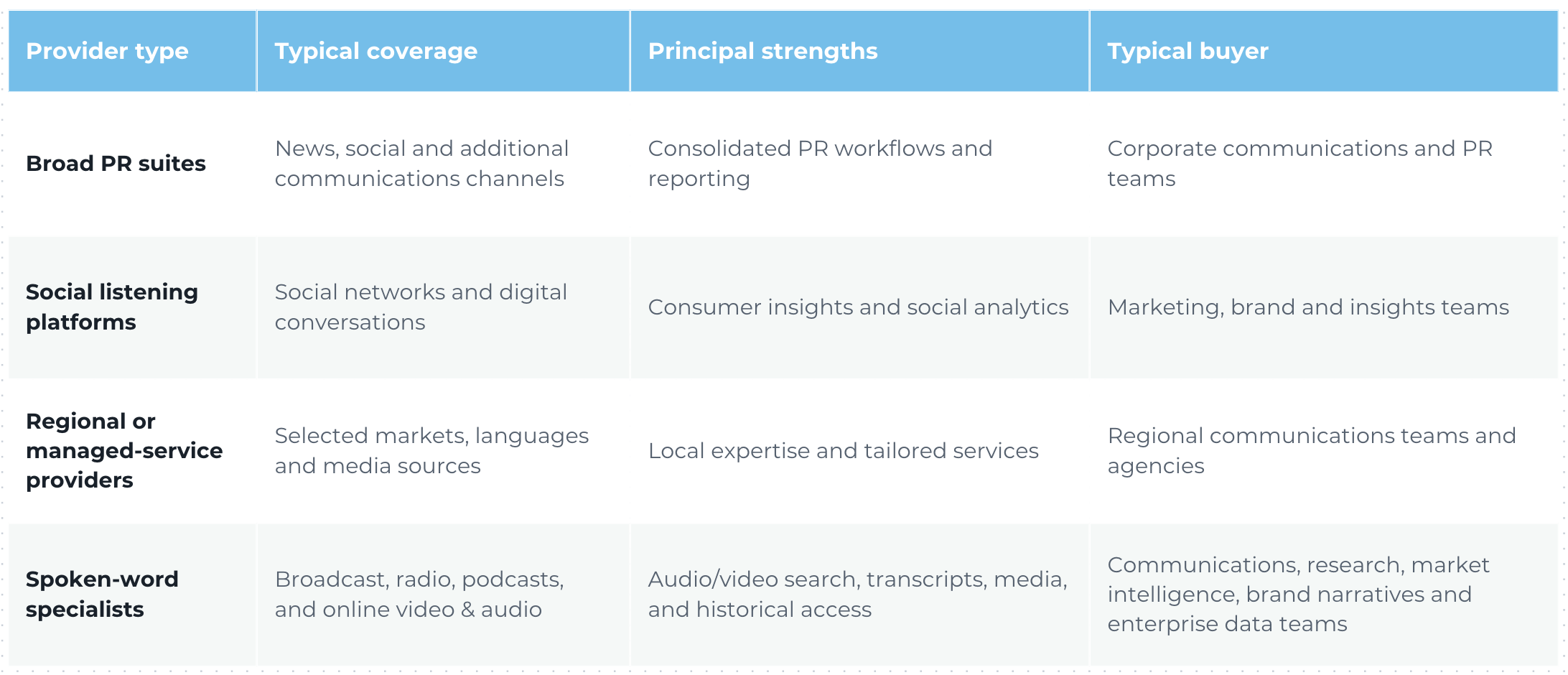
The current media monitoring industry can be viewed through four broad provider categories.
Specialists in spoken-word media
In many cases, the most significant and amplified brand conversations begin to emerge in an audio or video conversation, presentation, or developing story. Television, radio, podcasts, and online video & audio continue to be among the most influential content and platforms that impact markets and reputation. This is where TVEyes has specialized its own media monitoring and intelligence efforts.
Knowledge speed is also more important than ever. The window of time between a mention and an alert to an organization or executive is vital today. The faster the alert, the faster the conversation is managed. Other important capabilities include data integration, hyper-relevant sources, transcript quality, clipping, and the ability to search historical content.
TVEyes has a long history and focus on this specialist category. TVEyes has been a global leader in broadcast data for over 25 years. And has also been at the forefront of making global podcasts actionable intelligence. TVEyes’ media monitoring of television, radio, podcast, online video and additional audio sources is relied upon by professionals across major Fortune 500 brands, Federal and local governments, and many other types of market leaders. In addition to our trusted and actionable sources, we have an intense focus on the speed in which we provide signals to our clients. Today, the amount of time between a mention in the media to a TVEyes actionable alert is well under four minutes. This is among the fastest in the industry. TVEyes also provide the ability through to research valuable mentions from the past through our TVEyes Archive+ historical database spanning 15+ years of intelligence. This provides an additional view into the evolution of brands and market-moving narratives.
Broad PR Platforms: Monitoring multiple sources in addition to outreach and distribution
Platforms and valued TVEyes partners such as Cision and Muck Rack expand upon media monitoring through software and applications that include journalist research, media relations, press release distribution, additional offline sources, reporting and analytics. These all-in-one media monitoring platforms are a perfect fit for a communications teams that want to consolidate workflows.
Social listening and digital-first platforms
Providers such as Talkwalker and Brandwatch focus on social media monitoring tools around social listening, digital conversations, consumer insights and trend analysis. They help teams understand audience behavior and brand perception across various social media channels and handle monitoring at scale.
Regional and managed-service monitors
Regional specialists and managed-service providers, offer localized coverage, market expertise, customized reporting or human-assisted analysis. They can be particularly useful when buyers need deep knowledge of specific countries, languages, or industries.
These four broad categories prioritize different things: consolidated workflows, social conversations, local market focus or spoken-word depth and insights. Most providers span more than one category, so the right tool depends on which sources, languages and parts of the media landscape matter most to your organization
The table below provides a high-level comparison across provider types and typical buyers:
Spoken-word media is becoming more important than ever within the core coverage
Television, radio, podcasts and online video and audio remain important sources of public commentary and market influence. This importance has been significantly amplified as AI expands the amount of data covered. News interviews, expert discussions, and other media coverage across television, radio, podcasts and online video and audio now shape brand narratives and reputations more than ever. Mentions and market developments in these authentic, trusted and actionable sources often ignite interest on and serve as signal catalyst on social and other platforms
Organizations now increasingly benefit from relying upon authentic, trusted, and actionable audio and video intelligence. Heightened evaluation of these spoken-word sources alongside other types of media and coverage significantly increases the overall value of media monitoring its impact on brand management and market moving decisions.
The Increasingly Important Focus on Historical Data
Real-time alerts answer an immediate question: What is happening now? Historical data answers a different set of questions: How has this narrative changed? When did a competitor begin emphasizing a particular message? How has a brand’s visibility evolved over time?
TVEyes announced Archive+ in September 2026, positioning the offering around searchable historical broadcast and podcast content for enterprise intelligence and research. The announcement describes nearly two decades of global broadcast history and years of podcast content. [Source: TVEyes, September 2, 2026]
Historical archives and other structured datasets support longitudinal analysis, custom applications and support AI-driven research. For enterprise buyers in particular, the ability to access and operationalize historical data is a key part to analyzing long term trends and competitive dynamics.
Global and multilingual coverage as a differentiator
Global organizations have a need to understand conversations across markets, languages and regional media environments. A monitoring coverage list alone is not enough: buyers should also consider transcription quality, translation performance, local source availability and the ease of which global content is searchable.
What Buyers Should Know Before Choosing a Media Monitoring Provider
Selecting a media monitoring provider is about far more than just comparing feature lists or subscription prices. Buyers should establish their most important use cases and test providers against actual monitoring requirements. Not all sources are equal, and more is not always the answer. The real value is in the authenticity of the source and its ability to move markets and shape brands.
Key considerations include:
- Sources: Which television, radio, news, podcast, social and online video sources are included? Are there meaningful gaps?
- Languages: Which languages and regional sources are supported, and how accurate are transcripts and translations?
- Latency: How quickly does content become searchable and available for keyword alerts?
- Archive depth: How far back can users search? Are historical records complete and consistently searchable?
- Accuracy: How well does the platform identify relevant mentions, distinguish similar names and handle transcription errors?
- Exports and APIs: Can data, transcripts, clips and metadata be integrated into internal dashboards, data warehouses, or AI workflows?
- Evidence and reporting: Can teams verify findings against original content and share usable evidence with stakeholders?
- Total investment: What are the limits, licensing conditions, add-on fees and service requirements?
A practical evaluation should the organization’s own brand and heritage, competitors, and priority topics. The best platform is the one that provides actionable intelligence organizations can reliably act on and leverage to improve their brands and competitive positioning. To help with this type of evaluation, please see our complete guide to media monitoring best practices.
Where TVEyes Fits
The future of media monitoring belongs to providers that help organizations effectively move from collecting coverage to extracting intelligence. TVEyes specializes in authentic, trusted and actionable sources across broad video and audio datasets ands intelligence. We make spoken-word media more accessible, searchable and useful for PR and communications professionals, market researchers, and global enterprise teams, among other leaders.
With real-time broadcast monitoring, podcast monitoring, and online video and audio capabilities, plus Archive+ for historical broadcast and podcast intelligence, and many other forms of data and intelligence, TVEyes addresses the needs that extend beyond today’s headlines. The combination of current coverage from trusted, actionable sources and historical context creates opportunities to understand market dynamics and how narratives from the spoken word develop over time.
“For decades, organizations have relied upon media monitoring to understand how the world is talking about them,” said Daren Benzi, Chief Commercial Officer for TVEyes. “In the decade ahead, they will increasingly rely on media intelligence to understand how the world is changing around them. That shift— from measuring coverage to identifying market moving signals— represents one of the most significant opportunities our industry has even experienced.”
The Business of Media Monitoring Is Becoming the Business of Intelligence
The media monitoring business is expanding as organizations contend with more content, higher expectations for timely evidence, and an increasing need to understand the context behind media coverage. The competitive landscape spans broad communications suites and specialist providers, each serving different monitoring and intelligence needs.
TVEyes brings real-time broadcast, podcast and online video monitoring together with Archive+, its historical broadcast and podcast dataset, for teams that need to understand both the present and the past.
See how the TVEyes media intelligence platform monitors broadcast, podcast and online video in one place. Start a media monitoring free trial.
Television, radio, podcasts and online video and audio remain important sources of public commentary and market influence. Interviews, advertisements, news segments and expert discussions often shape reputation and reveal developments that text-only monitoring may miss. Mentions in traditional media, such as a morning news segment, often spread fast to social and other platforms
Organizations increasingly benefit from relying upon trusted and actionable audio and video intelligence. Heightened evaluation of spoken-word monitoring alongside print, online and social coverage significantly increases the value of media monitoring and the impact that it has on brand management and market making decisions.
From Monitoring to Intelligence: Historical Data, APIs and AI-Ready Datasets
Real-time alerts answer an immediate question: What is happening now? Historical data answers a different set of questions: How has this narrative changed? When did a competitor begin emphasizing a particular message? How has a brand’s visibility evolved over time?
TVEyes announced Archive+ in September 2026, positioning the offering around searchable historical broadcast and podcast content for enterprise intelligence and research. The announcement describes nearly two decades of global broadcast history and years of podcast content. [Source: TVEyes, September 2, 2026]
Historical archives, structured datasets and a media monitoring API can support longitudinal analysis, custom applications and AI-driven research. For enterprise buyers, the ability to access and operationalize data can be as important as the monitoring interface itself.
Global and Multilingual Coverage as a Differentiator
Global organizations need to understand conversations across markets, languages and regional media environments. A monitoring coverage list alone is not enough: buyers should examine transcription quality, translation performance, local source availability and the time required to make content searchable.
What Buyers Should Know Before Choosing a Media Monitoring Tool
Selecting a media monitoring tool requires more than comparing feature lists or subscription prices. Buyers should establish their most important use cases and test providers against actual monitoring requirements. Not all sources are equal, and more is not always the answer. The real value is in the authenticity of the source and its ability to move markets and shape brands.
Key questions include:
- Sources: Which television, radio, news, podcast, social and online video sources are included? Are there meaningful gaps?
- Languages: Which languages and regional sources are supported, and how accurate are transcripts and translations?
- Latency: How quickly does content become searchable and available for keyword alerts?
- Archive depth: How far back can users search? Are historical records complete and consistently searchable?
- Accuracy: How well does the platform identify relevant mentions, distinguish similar names and handle transcription errors?
- Exports and APIs: Can data, transcripts, clips and metadata be integrated into internal dashboards, data warehouses, or AI workflows?
- Evidence and reporting: Can teams verify findings against original content and share usable evidence with stakeholders?
- Total investment: What are the limits, licensing conditions, add-on fees and service requirements?
A practical evaluation should include a real-world test using the organization’s own brand, competitors, spokespeople and priority topics. The best platform is the one that provides actionable intelligence organizations can reliably act on and leverage to improve their brands and competitive positioning. To build a monitoring program around that test, see our complete guide to media monitoring best practices.
See how the TVEyes media intelligence platform monitors broadcast, podcast and online video in one place. Start a media monitoring free trial.
FAQs
How big is the media monitoring market?
Estimates vary by research firm and market definition. IMARC Group reported that the media monitoring industry grew from $5.1 billion in 2025 to $6.2 billion in 2026, with anticipated market growth to $13.8 billion by 2034.
Who are the biggest media monitoring companies?
Many of the larger providers rely upon TVEyes for their broadcast and podcast content and data, as TVEyes is the industry leader in both categories. Additional frequently cited providers include Cision, Muck Rack, Talkwalker, Brandwatch, Meltwater, Onclusive, Sprinklr, and Hootsuite. Their relative positions depend on the segment, geography and criteria used to assess leadership.
What is driving growth in media monitoring?
Growth is being driven by the expanding need for signals and intelligence, and a focus on the datasets most likely to impact the market and narrative first. This includes spoken-word content, reputation and crisis intelligence, competitive research, and new AI-powered tools that expand media search and analysis.
What is the difference between media monitoring and media intelligence?
Media monitoring identifies and tracks relevant coverage across media sources. Media intelligence goes further by analyzing that coverage, connecting it with historical information and other data, and turning the findings into insights and signals that inform business decisions. Learn more about media monitoring vs. media intelligence.