
It’s November, it’s almost the holiday season, and you’re preparing your PR strategy budget for 2027. Your team secured dozens of media mentions this year, landed an executive interview on a major podcast, and generated coverage around a new product launch. But now leadership wants to know which PR activities delivered the most value and where next year’s budget should go. Can you back up your recommendations with data?
According to Cision and PRWeek’s 2025 Comms Report, 44% of communications leaders struggle to align their metrics with revenue or business KPIs.1 A full-year media coverage review helps address this challenge by connecting PR efforts with measurable outcomes, giving your team stronger evidence to justify budgets and set achievable priorities for 2027.
Key Takeaways:
- Review your full-year media coverage to establish a reliable baseline for setting 2027 PR goals, budgets, and priorities.
- Measure performance against your original KPIs, rather than relying on mention volume or estimated reach alone.
- Identify what drove coverage peaks and declines to understand which campaigns, announcements, and media tactics delivered results.
- Benchmark your coverage against competitors to uncover gaps in share of voice, media placements, and industry visibility.
- Combine year-end findings with historical media data to distinguish long-term trends from short-term changes and build a more informed PR strategy plan.
Why Year-End Is the Right Time to Audit Your Media Coverage
A year-end audit reveals which campaigns earned attention, where your competitors gained ground, and what deserves a bigger share of the budget.
A year-end coverage review helps you understand:
- Which PR campaigns and media activities delivered the strongest results.
- How your media visibility compared with competitors.
- Which outlets, stations, and podcasts generated valuable coverage.
- Which emerging industry narratives present opportunities for 2027.
- Where to adjust your budget, messaging, and media outreach strategy.
Coverage is the evidence behind goals, budget, and headcount asks
Imagine requesting an additional $50,000 for your 2027 PR budget. Stakeholders will want to know what the investment could deliver. A media monitoring tool helps you demonstrate how previous campaigns performed, which outlets generated the most coverage, and where additional resources could make a measurable difference.
Reviewing once a year vs. measuring year-round (why a baseline you keep current saves time)
Modern public relations strategies span numerous media channels, from local radio to podcasts. Reconstructing 12 months of coverage across these sources can be extremely time-consuming. That is why the media monitoring industry increasingly values broadcast, radio, and podcast data.
For example, a podcast campaign launched in Q1 may generate mentions across dozens of shows. Using PR tools to track media coverage throughout the year means your December review already has the data needed to measure results, rather than spending weeks reconstructing which podcasts featured your brand and when.
Step 1: Build a Full-Year Coverage Baseline
Whether your PR strategy requires podcast monitoring or local radio broadcast data, it’s crucial to consolidate coverage across all relevant channels to establish an accurate baseline for year-over-year comparisons.
Pull broadcast, radio, podcast, and online video, not just print and web
Tradition media is often overlooked in comparison to social media channels and digital PR channels when evaluating coverage. However, Nielsen reports that radio reaches 92% of U.S. adults monthly.2
Core numbers: mentions, reach, stations and shows, program categories, volume by month
A PR strategy report that helps you refine your approach for 2027 should cover:
- Media mentions: How frequently your brand appeared in coverage.
- Audience reach: The estimated number of people exposed to your coverage.
- Audience demographics: The age groups and other audience characteristics your coverage potentially reached.
- Geographic reach: The countries, regions, and local markets where your coverage helped increase brand awareness.
- Stations, shows, and program categories: Which media outlets and types of programming featured your brand.
- Monthly coverage volume: How media attention fluctuated throughout 2026.
Compare to the prior year so the baseline has context
Context is key, as it provides direct insight into how your brand’s media performance has evolved over time. Comparing 2026 coverage with 2025 allows you to measure progress against your own previous results rather than focusing exclusively on competitors. It also reveals whether your PR strategy is gaining momentum or running out of steam.
Step 2: Measure Results Against This Year’s Goals
With your coverage baseline established, compare your 2026 results against the original PR objectives to identify which targets you achieved and missed.
Which KPIs You Set and Which You Hit
Perhaps your goal was to secure coverage in five leading technology news outlets during 2026. Did you achieve it, and did those placements reach your target audience? KPIs should go beyond traditional metrics like mentions and reach to include audience relevance, message penetration, and how that data drives business outcomes.
Separate Earned From Paid Coverage So Ad Airtime Does Not Inflate Results
Report paid advertising and earned editorial coverage separately because they represent fundamentally different PR outcomes. For example, your company might receive an organic mention on a leading industry podcast alongside several paid placements in smaller, second-tier publications.
While the paid placements may generate more total mentions, the podcast appearance could carry greater credibility and reach a more relevant audience. Combining these results can distort your assessment of PR performance, making it harder to determine which activities deserve a larger share of your 2027 budget.
Step 3: Find What Drove Your Peaks and Valleys
Data showing when your media coverage dropped off is just as important as the numbers that put a smile on your CEO’s face.
Match Spikes to Launches, Announcements, Executive Appearances, or News Events
An AI company might see a sharp increase in media coverage after launching a new language model, with interviews on technology podcasts and mentions across major news outlets. By matching these spikes to specific announcements or events, your team can identify which newsworthy moments attracted journalists’ attention and plan similar opportunities for 2027.
Look at What Happened in the Weeks Before a Dip
A dip in media coverage hurts, but it can provide valuable data that opens the door to more effective PR in future campaigns. Examine the preceding weeks for reduced media outreach, shifting news priorities, or increased competitor activity. Identifying these patterns helps prevent similar declines in 2027.
Step 4: Benchmark Your Public Relations Strategies Against Competitors
Internal data isn’t enough; you also need to compare your results with competitor campaigns. This benchmarking reveals where your brand is gaining or losing media visibility.
Share of Voice on the Topics That Matter to Your Business
Share of voice measures your brand’s share of media coverage relative to competitors. For example, an electric vehicle battery manufacturer might track mentions of solid-state battery technology across automotive podcasts and industry news outlets. Comparing its coverage against rival manufacturers reveals whether it’s leading the conversation or losing visibility on a strategically important topic.
Where Competitors Got Coverage You Did Not, and on Which Shows or Stations
One of the most valuable ways to use your 2026 media coverage data is to pinpoint where competitors secured mentions that your brand missed. These gaps might include local radio stations, industry podcasts, or national television programs. Use them to build a targeted pitching list for 2027, choosing the right journalists and shows already covering your industry so you can build relationships with them.
Step 5: Review Your Sources and Spokespeople
Understanding your 2026 media coverage can reveal which outlets and spokespeople generated the most attention, helping you strengthen media relationships and improve future pitches.
The Outlets, Programs and Podcasts That Carried Your Story, and the Ones You Were Absent From
Identify the publications, programs, and podcasts that generated valuable exposure throughout 2026. Using broadcast monitoring, you can assess which television and radio programs featured your brand. Compare these results with relevant outlets where you received little or no coverage to sharpen your 2027 pitching strategy.
Which Spokespeople and Message Points Earned Airtime
Who mentioned your brand can be just as important as where and when they said it. Review which executives, industry experts, and company spokespeople secured the most valuable coverage in 2026. Identify which key messages journalists repeated and use those findings to refine your messaging, media training, and spokesperson selection for 2027.
Step 6: Understand Your Audience and Spot the Narratives to Own in 2027
Your 2026 coverage reveals which industry conversations attracted the most attention and where your brand could establish a stronger voice in 2027.
Topics and Frames Dominating Your Category
Review your 2026 coverage to identify which industry narratives gained traction and how journalists presented them. Focus on these three concepts:
- Recurring topics: Which issues consistently attracted coverage?
- Media framing: Were these stories presented as opportunities, risks, or controversies?
- Audience response: Which narratives resonated with your target markets?
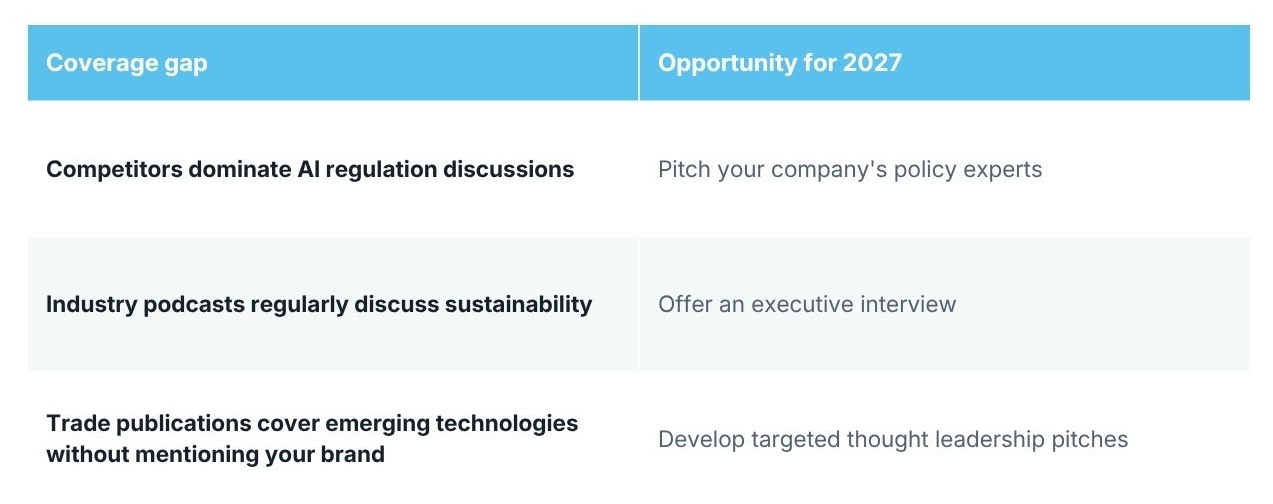
Gaps: Themes With High Coverage Where You Have Little Presence
High coverage of an industry topic doesn’t necessarily mean your brand is part of the conversation. Identifying gaps can reveal opportunities for your 2027 PR strategy. For example, consider these potential gaps:
Step 7: Turn Findings Into a 2027 PR Plan
With your 2026 coverage reviewed, it’s time to start building a PR strategy by translating those findings into specific 2027 priorities.
Set Goals Tied to What the Data Showed, Not Last Year’s Targets by Default
Failing to leverage last year’s data could mean increasing your media mention targets even as audience relevance declines. Instead, set clear goals by prioritizing measurable improvements that address actual weaknesses and unlock new opportunities.
Choose Target Outlets, Shows and Podcasts; Align Messaging and the Editorial Calendar
A luxury fashion brand might discover that its 2026 collection launches received little attention from Vogue and Harper’s Bazaar, while competitors secured features. For 2027, the brand could prioritize these outlets, tailor pitches to their editorial interests, and schedule outreach around fashion weeks and seasonal launches. This uses the previous year’s coverage gaps to guide your 2027 PR plan.
Build in Quarterly Checkpoints to Adjust
Adjustments shouldn’t happen only once a year. Your PR team should receive regular performance updates, allowing quarterly changes to campaigns and your PR strategy. Following media monitoring best practices helps keep those updates consistent and actionable.
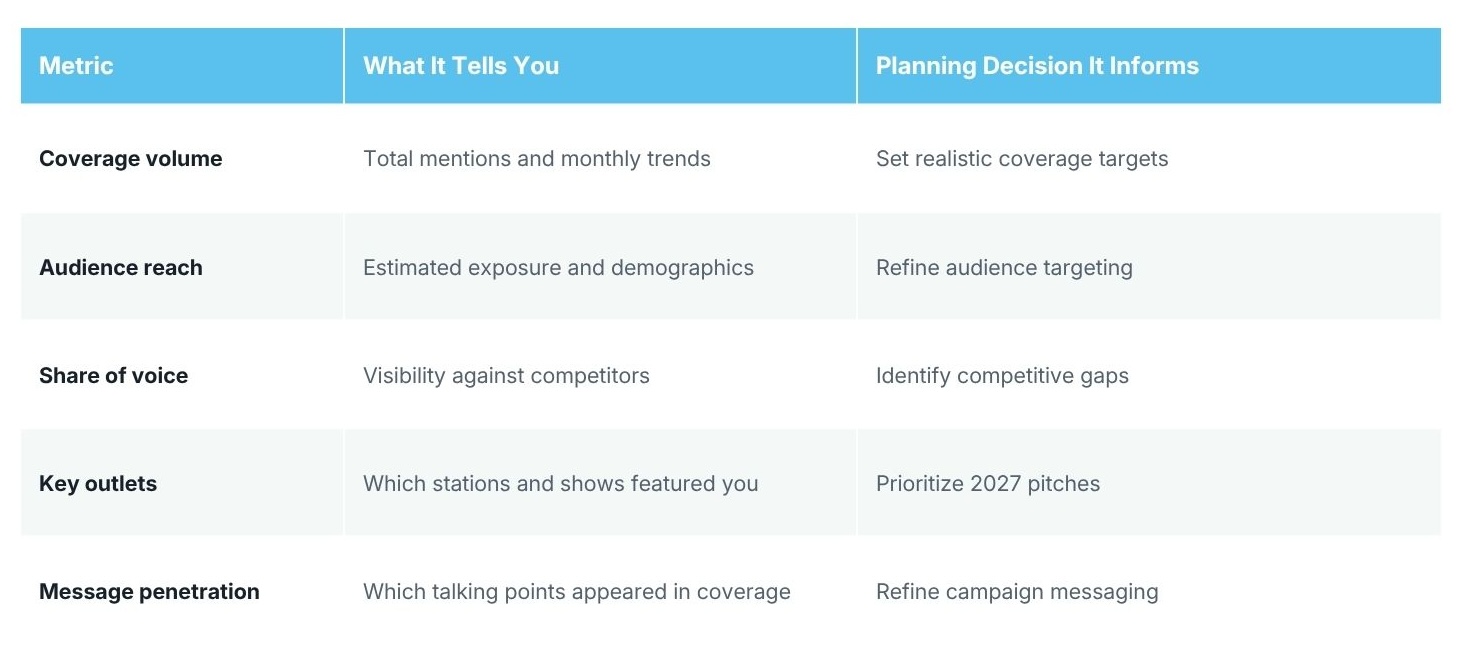
Original Asset: Year-End Coverage Review Checklist
Go Further: Add Historical Context to Build a Strong PR Strategy
Looking back beyond 2026 helps distinguish recurring coverage patterns from genuine shifts in your brand’s media visibility. This is where media intelligence vs. media monitoring comes into play. Monitoring captures what’s being said today, while intelligence adds the historical context to plan ahead.
Compare 2026 Against Two or Three Prior Years to Separate Seasonality From Real Change
Access to a historical media archive lets you compare several years of coverage and distinguish seasonal fluctuations from genuine shifts in media visibility.
Check What Past Launches and Crises Looked Like in Coverage Before Planning Similar Moments
Reviewing media coverage from previous launches and crises helps you anticipate changes in public perceptions, refine messaging, and prepare your 2027 PR strategy.
How Archive+ Supports This: Historical Broadcast Data Back to 2009
TVEyes Archive+ gives PR professionals access to historical broadcast coverage dating back to 2009 (with the most consistent data from 2012) and podcast content from 2019. Your team can build custom datasets filtered by keywords, stations, and date ranges. Hosted dashboards also help visualize coverage trends, leading stations, and program categories, making it easier to compare past campaigns and identify patterns to inform your 2027 PR strategy.
Build Your PR Strategy for 2027 With the Full Record of 2026
A well-crafted PR strategy for 2027 should build on the full record of 2026 coverage, revealing what worked, where competitors gained ground, and which narratives deserve attention.
TVEyes combines ongoing media monitoring with Archive+ historical intelligence to support data-based planning. Discover how these PR tools can strengthen your 2027 strategy by booking a free demo today.
Sources:
- Cision. PR Statistics: 2025 Comms Report by the Numbers. https://www.cision.com/resources/articles/pr-statistics-2025-comms-report/
- Nielsen. Everywhere, Everyone. https://www.nielsen.com/insights/2026/everywhere-everyone/
FAQs
How do you use media coverage for a PR strategy plan?
Start by reviewing last year’s coverage to understand which campaigns, outlets, and messages drove the strongest results. Compare those findings with competitor performance to identify gaps and opportunities. Use this evidence to set measurable goals, prioritize media outreach, and allocate your PR budget for the coming year.
What metrics should a year-end PR review include?
A comprehensive year-end PR review should cover:
- Media mentions: Total coverage and monthly fluctuations.
- Audience reach: Estimated exposure, demographics, and geographic distribution.
- Share of voice: Your visibility compared with competitors.
- Media placements: The outlets, stations, and podcasts featuring your brand.
- Message penetration: How frequently your priority messages appeared in coverage.
When should PR teams start planning for next year?
PR teams should ideally start planning in Q4, allowing time to review annual performance, set budgets, and prepare campaigns before January. However, ongoing monitoring and quarterly reviews should inform strategic decisions throughout the year.
How far back should I look when reviewing media coverage?
Review at least 12 months of coverage and compare it against the previous year. For a clearer picture of seasonal patterns and long-term trends, examine two or three additional years of historical media data.
Have more questions? Schedule a call with our Customer Support team or fill out this form to speak to one of our sales team members.