
You can’t afford to focus your brand reputation management purely on online reviews and social media. Those channels matter, but they only show part of how people form opinions about your company and its brand image. According to PwC’s 2024 Voice of the Consumer Survey, 70% of consumers seek reviews to validate a company before making a purchase. That shows how closely reputation can influence buying decisions. But reviews are only one part of the picture.
Your brand can also be discussed on TV, radio, podcasts, and online video, so managing online presence should be considered alongside broader media coverage. Imagine a local news segment criticizes one of your products and offers a negative review, and the story is then syndicated across several markets. If you are only monitoring reviews and social posts, your team may not see the problem until clips start circulating online. A full-channel approach to online brand reputation management gives you visibility across both digital and traditional media, helping you monitor and protect your reputation wherever and whenever the conversation happens.
🔑 Key Takeaways:
- Brand reputation is shaped across digital, broadcast, radio, podcast, and online video channels.
- Social listening and review monitoring only capture part of the conversation.
- Always-on brand reputation management helps brands identify potentially damaging narratives earlier.
- Positive earned media can create a strong reputation, maintain a positive brand, build trust, and be repurposed across marketing channels.
- Effective measurement combines digital and broadcast reputation signals.
What Is Brand Reputation Management?
Brand reputation management is the process of monitoring and influencing how customer experience and the wider public perceives your brand. It covers what people say about your company and how your team responds to positive, negative, or inaccurate coverage.
Conventional reputation management strategies tend to concentrate on reviews, search results, and social sentiment. BrightLocal’s 2025 research found that just 4% of US consumers never read online business reviews.
But reviews only capture one source of public opinion. A customer could hear your company discussed during their commute, watch an executive interview on TV, or encounter criticism during a podcast. Each can shape perception without appearing on a review platform, which is why online reputation depends on more than just review activity.
A complete approach should monitor:
- Search and reviews: Search results and review platforms.
- Social media: Posts, comments, and audience sentiment.
- Broadcast media: Local and national TV and radio coverage.
- Podcasts and online video: Spoken mentions that text-based monitoring can miss.
Your effective reputation management needs to follow your audience across every relevant channel. A podcast discussion or local news report can shape public perception just as much as a Yelp review or social media post.
The 3 Cs of Brand Management and the Channel Gap They Expose
The 3 Cs of online brand reputation management are Consistency, Clarity, and Constancy. Together, they help you maintain a recognizable brand and manage how it is presented to your audience:
- Consistency: Your messaging and identity should remain consistent across all channels, including in how third parties represent your brand.
- Clarity: Your audience should understand what your brand stands for. You need to identify inaccurate media narratives quickly before they distort that message.
- Constancy: Reputation management requires continuous attention, as periodic checks can leave damaging coverage unnoticed for hours or even days.
There is an additional, often overlooked dimension: Coverage. You need to know what is actually being said about your brand across the media. According to Pew Research Center, 65% of U.S. adults often or sometimes get local news from TV stations, while 52% do so from local radio stations.
Those audiences are too large to leave outside your reputation strategy. The 3 C’s depend on knowing what third parties are saying about your brand and maintaining brand consistency across channels; you can’t protect consistency, preserve clarity, or maintain constant oversight over coverage you can’t see.
Where Brand Reputation Is Actually Formed: The Full Channel Map
Your brand reputation is formed wherever people encounter information or opinions about your company. Reviews and social posts are part of that picture, alongside news reports, radio discussions, podcasts, and independent video content. Your monitoring strategy needs to reflect this full channel map.
Online channels include search results, review sites, forums, and social media. Broadcast expands that to local and national TV, AM/FM radio, and syndicated programming. Podcasts and streaming audio add long-form conversations, while online video includes everything from YouTube reviews to news commentary. The Reuters Institute Digital News Report 2026 found that trust in news on social media stood at just 22%, compared with 37% for news overall.
Differences in trust across channels should directly influence how you assess reputational risk; a negative online story from a trusted news outlet may carry more weight than the same criticism on social media. Mention volume alone can therefore be misleading. You also need to understand where coverage appeared, who encountered it, and how much authority the channel carries before deciding how to respond.
How to Manage Your Brand Reputation Across Every Channel
Your online brand reputation management needs to cover every channel where people talk about your company. That means combining conventional social and review monitoring with always-on visibility across TV, radio, podcasts, and online video, so your team can quickly detect important mentions, identify negative feedback, and act on it.
Setting Up Social and Review Monitoring
The easiest channels to track provide a strong foundation for your reputation monitoring. Google Alerts, review platform dashboards, and social listening tools can surface new reviews, customer feedback, brand mentions, and changes in audience sentiment. Set alerts for high-velocity or potentially damaging keywords, then use weekly sentiment roll-ups to identify broader changes in how people perceive your brand.
Adding Broadcast and Radio Monitoring to Your Stack
Why does this matter? Social and review monitoring only works when the conversation happens on channels those tools can see. Broadcast monitoring extends that visibility to TV and radio using closed-caption search, audio fingerprinting, and transcript indexing. A media monitoring service can then alert your team when tracked brand names or keywords appear, allowing you to review and respond to feedback quickly.
Monitoring Online Video
Monitoring your brand’s appearance in video content can be technically challenging, but consumers increasingly use platforms such as YouTube for information. Pew Research Center found that 35% of U.S. adults regularly get news from YouTube. This makes online video a crucial pillar of brand reputation management, requiring transcript-based monitoring that can identify spoken brand mentions that conventional text searches may miss.
Monitoring Podcasts and Streaming Audio
Podcasts are becoming central to both entertainment and news consumption. Edison Research’s Infinite Dial 2026 found that 58% of Americans aged 12+ consumed a podcast in the previous month, an all-time high. Yet many monitoring tools still overlook podcast mentions, making transcript-based search essential for tracking what hosts and guests say about your brand.
Scaling Online Brand Reputation Monitoring for Enterprise Teams
As your company grows, reputation monitoring becomes harder to coordinate; a local TV mention may matter most to a regional PR team, while a national story needs immediate attention from corporate communications. Podcasts and online video may sit with another team entirely.
Centralized reputation intelligence connects those workflows. Real-time media alerts, clips, reporting, and escalation routes give each team access to relevant coverage while maintaining a company-wide view of how the brand is being represented.
Brand Reputation Crisis Response: When Something Airs That Hurts You
Your monitoring system becomes especially valuable when negative coverage appears, giving you a chance to follow a crisis management plan before the story spreads. A damaging broadcast story can spread through syndication, rebroadcasts, online clips, and social sharing. This creates a rebroadcast multiplication problem, where reputational impact grows as the story reaches new channels and markets.
Waiting until customers share clips on social media puts your team on the back foot. Your response should begin as soon as damaging coverage is detected:
Detect → Assess reach and tone → Identify the outlet and journalist → Respond through the appropriate channel
Speed matters. Institute for Public Relations research on crisis communication identifies timing as a core factor and finds that being the first to report a crisis can benefit an organization. Early detection gives your team more time to assess the threat, correct inaccuracies, and respond before coverage spreads.
Proactive Reputation Building Through Traditional Media
Protecting your brand from negative coverage is only one side of reputation management; positive earned media can proactively strengthen audiences’ perception of your company. CEO interviews, product features, expert commentary, and relevant news appearances provide third-party exposure that can add credibility your own marketing can’t replicate.
Once positive coverage appears, extend its value by repurposing it across:
- Short-form social clips
- Investor communications
- Sales materials
Tracking broadcast share of voice through enterprise monitoring solutions also shows how frequently your brand appears compared with competitors, helping your team measure whether that visibility is growing over time.
Measuring Brand Reputation Management Effectiveness
Building positive coverage is only useful if you can measure its impact. Effective measurement lets your team demonstrate results to brand owners and leadership, while also showing changes in brand sentiment and where your reputation management strategy needs adjusting to deliver better outcomes.
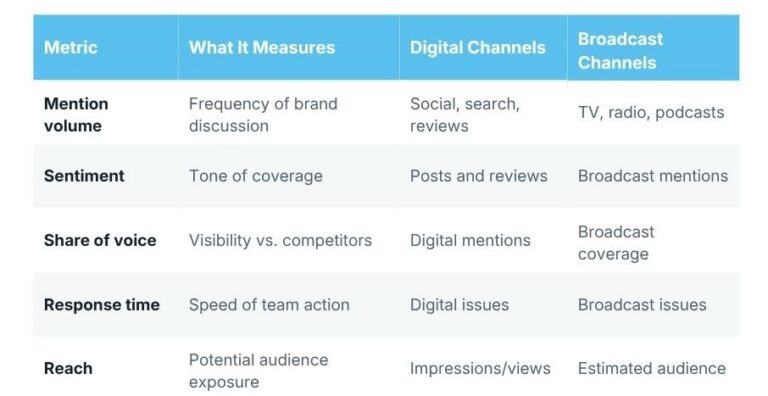
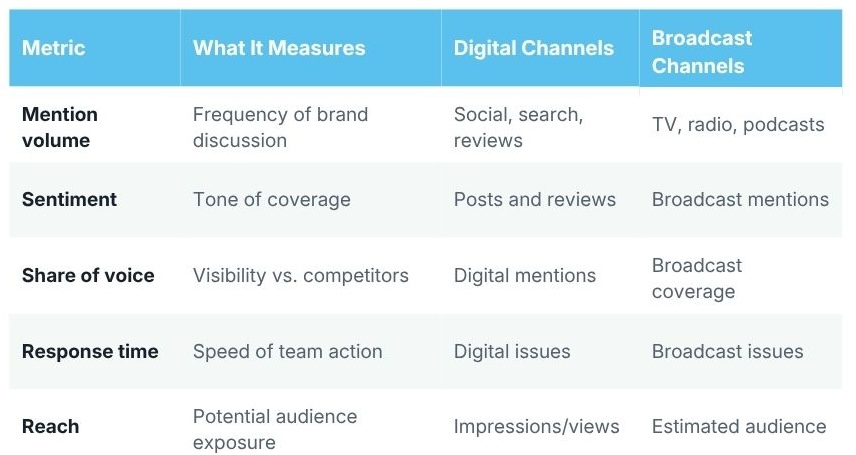
A unified reputation dashboard should bring digital and broadcast signals together, giving you a clearer view of how perception is changing and whether your media efforts are working. Reporting should reflect who needs those insights; PR teams may need weekly updates, communications leaders may need monthly analysis, and executives may need a broader quarterly view.
Reputation KPI by Channel
Turn Full-Channel Visibility Into Stronger Brand Reputation
Strong brand reputation management comes back to the 3 Cs: Consistency, Clarity, and Constancy. But achieving all three requires coverage. You need to know how your brand is represented in reviews and on social media, as well as on TV, radio, podcasts, and online video.
That volume makes manual monitoring impractical, which is where a comprehensive media monitoring tool comes in. TVEyes monitors more than 111,000 media sources across 50+ countries and 41 languages, processing over 2.5 million hours of media every month. Your team gets the visibility needed to identify damaging coverage, measure positive exposure, and understand how your reputation is changing across channels.
Ready to see your brand reputation beyond reviews and social media? Start your TVEyes media monitoring free trial today and get the full-channel visibility your team needs to protect and strengthen your reputation.
1. PWC. PwC 2024 Voice of the Consumer Survey. https://www.pwc.com/gx/en/news-room/press-releases/2024/pwc-2024-voice-of-consumer-survey.html
2. BrightLocal. Local Consumer Review Survey 2025. https://www.brightlocal.com/research/local-consumer-review-survey-2025/
3. Reuters Institute. Digital News Report 2026. https://reutersinstitute.politics.ox.ac.uk/digital-news-report/2026
4. Pew Research Center. Social Media and News Fact Sheet. https://www.pewresearch.org/journalism/fact-sheet/social-media-and-news-fact-sheet/
5. SSRS. The Infinite Dial® 2026. https://ssrs.com/insights/the-infinite-dial-2026/
6. Institute for Public Relations. State of Crisis Communication: Evidence and the Bleeding Edge. https://instituteforpr.org/wp-content/uploads/CoombsFinalWES.pdf